Monstera
Vietciosa
Shield-shaped leaves with cream streaks: climb it if you want the stripes to stay straight and the blade to thicken.
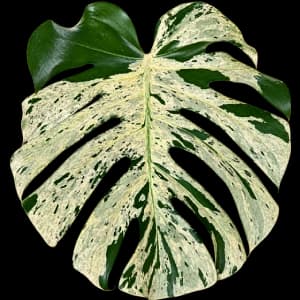
Monstera Vietciosa is a Monstera deliciosa cultivar developed in Vietnam and known for its changing variegated coloration, combining green foliage with cream-white, creamy-yellow, and yellow-green areas. The name Vietciosa was introduced after the plant previously marketed as “Monstera Viet Truong Sa” was renamed because of trademark considerations involving a geographic place name. According to Xanh Xanh Urban Forest, the name Vietciosa combines “Viet” with “deliciosa,” reflecting the plant's Vietnamese origin.
What makes Vietciosa special?
The most distinctive feature of Vietciosa is the way its colors appear across each leaf. The foliage can display marbled areas, speckles, and patches of creamy white, creamy yellow, or yellow-green against a green background. As the plant matures, its leaves can become larger and more deeply fenestrated, creating a dramatic overall appearance.
Vietciosa has been described as having been developed from Monstera deliciosa tissue-culture material using EMS-induced mutation in Hanoi. However, this information is currently based primarily on information from the developer and commercial sources, so it should not be treated as an independently published scientific characterization.
Vietciosa's color can change with temperature
One particularly interesting characteristic reported for Vietciosa is that temperature during leaf development can influence the expression of its coloration. According to information associated with the original developer, cooler conditions tend to produce darker green foliage with white markings, while warmer conditions can result in lighter green foliage with more yellow-green coloration.
This makes Vietciosa especially interesting to observe across multiple growth cycles. Two leaves on the same plant do not necessarily develop exactly the same colors because the environmental conditions during leaf formation can also influence how each leaf looks.
For that reason, it is better not to judge the overall coloration of a Vietciosa from a single leaf. New growth, the stem, and the environmental conditions during development all provide useful clues about the plant.
Vietciosa's leaf form
Along with its coloration, Vietciosa is notable for large leaves with deep fenestrations as the plant matures. Well-developed leaves can display the characteristic structure of Monstera deliciosa, with broad foliage and increasingly pronounced splits as the plant grows.
The plant has a climbing growth habit. When given suitable support, the vine can continue growing upward, allowing new leaves to develop larger over time. As a result, a mature Vietciosa can become a substantial feature plant rather than remaining a small tabletop specimen.
Light for Monstera Vietciosa
Vietciosa prefers bright, indirect light. Good light supports active growth and provides the green tissue with the energy needed for photosynthesis. A bright position near a window with filtered natural light is a suitable option.
Avoid moving the plant suddenly from a low-light environment into intense sunlight. The lighter variegated areas can be more vulnerable to scorching under strong direct sun. If you need to increase the light level, do so gradually so the plant has time to acclimate.
Soil and root health
A healthy Vietciosa needs a healthy root system to support its increasingly large leaves. The growing medium should be airy, well-draining, and capable of retaining moderate moisture. A chunky aroid-style mix can provide useful air spaces around the roots while reducing compaction.
The goal is not simply to make the substrate dry as quickly as possible. After watering, excess moisture should drain efficiently while the root zone still retains enough moisture for active growth. This gives the roots access to both water and oxygen.
Watering Vietciosa
Vietciosa does not need to be watered according to a fixed schedule. Check the growing medium before watering and allow the upper portion to begin drying before watering again. When watering, thoroughly moisten the root zone and allow excess water to drain completely.
Keeping the plant continuously in wet substrate can put stress on the roots and slow growth. On the other hand, allowing the plant to become completely dry for an extended period can cause the leaves to lose firmness and interfere with new leaf development.
Humidity and environment
Vietciosa grows well in a warm environment with relatively stable humidity. It is still a tropical Monstera, so warm conditions, good light, and suitable humidity support healthy development.
Higher humidity should still be accompanied by good airflow. Stagnant air combined with an overly wet substrate can increase the risk of root and foliage problems. Indoors, keep the plant away from strong cold air-conditioning drafts and direct heat sources.
Keeping Vietciosa leaves beautiful
Color is one of Vietciosa's most attractive features, so clean and healthy foliage allows the pattern to stand out more clearly. A soft, slightly damp cloth can be used to gently remove dust from the leaf surface. It is also useful to inspect the undersides of the leaves and the petioles regularly for pests.
There is usually no need to rely heavily on leaf-shine products. Clean, healthy foliage is enough to reveal the natural combination of green, cream, and yellow across Vietciosa leaves.
Vietciosa as it matures
One of the most enjoyable parts of growing Vietciosa is watching the plant change over time. With sufficient light, nutrition, and climbing support, new leaves can become increasingly large and develop more pronounced fenestrations.
A moss pole or sturdy support becomes particularly useful once the plant begins developing as a climbing vine. Supporting the stem not only creates a more structured appearance but also allows new leaves to develop in the natural growth direction of a mature Monstera.
When should you repot?
Vietciosa does not need frequent repotting. Consider repotting when the roots have filled much of the container, the growing medium has begun to break down, or drainage has noticeably changed.
The new container should only be moderately larger than the previous one. An oversized pot can retain too much moist substrate around the root system, making moisture management more difficult.
Vietciosa – every leaf can tell a different story
What makes Vietciosa interesting is not only its Vietnamese origin, but also the way its coloration and leaf form can change from one growth cycle to another. Cream-white, creamy-yellow, and yellow-green areas can create different patterns, while temperature during leaf development has been reported as one factor that influences color expression.
The best approach to growing Vietciosa is to create stable conditions: bright indirect light, an airy growing medium, appropriate watering, suitable humidity, and a healthy root system. Under the right conditions, its large, deeply fenestrated, colorful leaves can become the defining feature of this distinctive Monstera.
Reviews
No reviews yet. Be the first to share your experience.