Monstera
Thai Cons
Cream speckling is more stable than Albo, but the white tissue still wants diffused light and a slower wet-dry cycle.
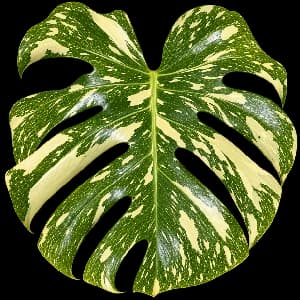
Monstera deliciosa ‘Thai Constellation’ is one of the most recognizable variegated Monsteras, celebrated for its dark green leaves covered with cream, creamy-white and white splashes, streaks and marbled markings. The scattered light-colored patterns resemble points of light across a night sky, which is the inspiration behind the name “Thai Constellation.”
Beyond its coloration, Thai Constellation retains the impressive large-leaf structure of Monstera deliciosa. As the plant matures, its leaves become larger and develop increasingly prominent slits and fenestrations. With suitable support, it can also grow vertically and eventually become a striking mature specimen.
What Makes Thai Constellation Special?
The greatest attraction of Thai Constellation is its constellation-like variegation. Rather than showing a simple white pattern, the cream and white areas appear as speckles, streaks and marbled sections mixed throughout the dark green leaf. As a result, almost every leaf develops its own unique color map.
Thai Constellation is also notable because its variegation is considered more stable than that of Monstera deliciosa ‘Albo Variegata’. Costa Farms notes that Albo can produce shoots that lose their variegation entirely, while Thai Constellation is regarded as more stable in maintaining its characteristic pattern.
The Color Changes From Leaf to Leaf
No two Thai Constellation leaves are completely identical. One leaf may contain larger cream-colored areas, while another may be covered with smaller speckles and more intricate marbling. Some leaves remain strongly green, creating a dramatic contrast with the lighter markings.
This variation is part of the plant's appeal. When a new leaf first unfurls, it can take time for the entire blade to expand before the full distribution of color becomes clear.
Why Does Thai Constellation Grow More Slowly?
Part of Thai Constellation's coloration comes from areas of foliage containing less chlorophyll. Chlorophyll plays an important role in photosynthesis, so a plant with a significant amount of variegated tissue generally has less photosynthetic tissue than a fully green Monstera. Costa Farms specifically notes that Thai Constellation grows more slowly because its creamy-white foliage contains less chlorophyll.
This does not mean the plant is weak or difficult to grow. With good light, healthy roots and stable conditions, Thai Constellation can eventually become a large and impressive plant. It simply rewards patience when waiting for each new leaf to reach its mature size.
Light for Thai Constellation
Light is one of the most important factors for Thai Constellation. It prefers bright, indirect light and generally benefits from more light than a completely green Monstera deliciosa.
A position near an east- or west-facing window with filtered light can work very well. A few hours of gentle morning sun may be tolerated after acclimation, but harsh midday or afternoon sunlight can scorch the foliage. If natural light is insufficient, a grow light can supplement it.
The goal is not simply to provide the strongest possible sunlight. The goal is to provide enough consistent light without exposing the creamy-white areas to excessive heat and direct sun.
Soil and Root Health
Thai Constellation prefers a loose, airy and well-draining growing medium that still retains a moderate amount of moisture. The root zone should never remain saturated for extended periods.
An aroid-style mix containing bark, perlite, coco fiber and other lightweight materials can provide a suitable balance between moisture retention and aeration. The container should also have adequate drainage.
This is particularly important for Thai Constellation because the plant is sensitive to overwatering. Costa Farms specifically warns that prolonged wet conditions can cause root problems and recommends allowing the growing medium to dry substantially between waterings.
Watering
Thai Constellation likes thorough watering but does not like sitting in wet soil. Check the growing medium before watering and allow a substantial portion of the upper mix to dry first. Costa Farms recommends allowing roughly the top half of the mix to dry, while another variety-specific guide recommends allowing the soil to dry closer to 75% because of the plant's sensitivity to overwatering.
When watering, soak the root ball evenly and allow all excess water to drain from the container. Never leave the pot sitting in standing water.
At the same time, avoid allowing the plant to become severely dehydrated for long periods. The creamy-white areas can develop browning when the plant becomes too dry or when the surrounding air is excessively dry.
Humidity and Environment
Thai Constellation can adapt to normal indoor humidity, but it generally performs better in a warm environment with above-average humidity. Costa Farms notes that it can tolerate average humidity around 40–55%, while levels above approximately 55% are more favorable.
When the air becomes very dry, leaf tips and margins—especially in the cream and white areas—may develop brown edges. A humidifier or grouping plants together can help create a more humid microclimate.
If the plant is kept in an air-conditioned room, avoid placing it directly in the path of cold or hot airflow. Stable temperature and humidity help new leaves unfurl more cleanly.
Helping Thai Constellation Produce Larger Leaves
Thai Constellation is capable of climbing. Providing a moss pole or sturdy support allows the stem to grow vertically and can encourage more mature foliage. Costa Farms also recommends growing the plant vertically on a support to encourage larger leaves.
Young plants may have relatively simple leaves with limited fenestration. As the plant matures, the leaves gradually become larger and develop more characteristic holes and splits. This transformation is one of the most rewarding parts of growing Thai Constellation—from a small tabletop plant into a large Monstera with dramatic foliage.
Keeping the Creamy Variegation Beautiful
The creamy-white areas are one of Thai Constellation's greatest attractions, but they also require some care. Excessive direct sunlight can scorch the lighter tissue, while very dry air or prolonged dehydration can cause the leaf margins and tips to turn brown.
Gently wiping dust from the leaves on a regular basis is also useful. Large Monstera leaves can collect dust easily, and clean foliage makes the constellation-like markings much more visible. Regularly inspect the undersides of the leaves as well so pests can be detected early.
When Should You Fertilize?
Thai Constellation is relatively slow growing, so heavy feeding is unnecessary. During active growth, a general houseplant fertilizer can be used according to the product instructions. Costa Farms recommends fertilizing during spring and summer and emphasizes avoiding over-fertilization because excessive fertilizer can damage the roots.
For a variegated Monstera, feeding heavily simply to force faster growth is not a good strategy. Healthy roots and stable growing conditions are more important than trying to accelerate the plant artificially.
Thai Constellation – A Plant Worth Waiting For
Thai Constellation is attractive not only because of its star-like markings, but also because of the way the plant transforms as it matures. A young plant may begin with relatively simple foliage, then gradually produce larger leaves with deeper fenestrations and increasingly impressive patterns.
The combination of dark green foliage, creamy-white marble and splash variegation, and the large leaf structure of Monstera deliciosa gives Thai Constellation a character all its own.
Perhaps the most enjoyable part of growing it is waiting for every new leaf to unfurl. Each one creates another little constellation—a pattern that belongs only to that particular leaf.
Reviews
No reviews yet. Be the first to share your experience.