Monstera
Green Snow
Thick, bullate leaves with no windows: water slowly and give it more light than the thin-leaved cousins.
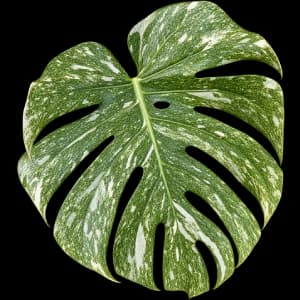
Monstera Green Snow is admired for its delicate variegation pattern. Rather than relying on large, dramatic sectors, its deep green leaves are covered with fine speckles, splashes, and soft areas of lighter color that resemble a thin layer of snow across the foliage. The markings can range from creamy white and pale cream to mint and lighter green, creating a subtle but highly detailed appearance when viewed closely. This snow-dusted effect is also what gives the plant its name.
What makes Green Snow special?
The defining characteristic of Green Snow is the distribution of its variegation. The lighter markings are often relatively small and scattered across the leaf rather than forming large solid sectors. Green remains the dominant color, while the numerous lighter details create texture and depth across the blade, giving the impression of snow scattered over a green surface.
Some sources describe Green Snow as belonging to the broader group of Monstera deliciosa associated with Thai Constellation, while other sellers present it as a distinct variegation type within the collector market. Because the name is currently used somewhat broadly in commerce, it is safer to focus on the characteristic variegation pattern rather than make a definitive claim about a specific genetic origin that has not been independently documented.
Leaves covered in snow-like details
Green Snow can produce leaves with different levels of speckling and variegation. Some leaves may show mostly fine dots and lighter green markings, while others can develop more cream and white splashes, creating a much stronger snowfall effect. Some plants also combine fine speckling with soft marbling on the same leaf.
This makes each new leaf part of the experience of growing the plant. You should not expect every leaf to have exactly the same amount of variegation. Even plants with relatively consistent patterns can show changes in the amount of lighter tissue from one growth cycle to another.
Leaf form as the plant matures
Along with its distinctive pattern, Green Snow retains the characteristic growth form of Monstera deliciosa. Young plants may have relatively intact leaves with limited fenestration. As the plant matures and begins climbing, the leaves can become larger and develop deeper splits and more pronounced internal fenestrations.
A moss pole or sturdy climbing support can help the plant grow upward and support mature foliage development. As the leaves become larger, the fine speckles and marbled markings also have more space to create their distinctive effect across the entire leaf.
Light for Green Snow
Green Snow prefers bright, indirect light. Good light supports the green tissue responsible for photosynthesis and helps maintain strong, healthy growth. A bright position near a window with filtered light is often a suitable choice.
However, placing the plant in intense direct sunlight is not a reliable way to improve its variegation. The lighter portions of the leaves can be more sensitive to harsh sunlight and may scorch. If the plant has been growing in low light and needs more illumination, increase the light gradually so it has time to acclimate.
Soil and root health
Green Snow benefits from a well-draining, airy growing medium that contains organic material while retaining a moderate amount of moisture. A chunky aroid-style mix can create air pockets around the roots and reduce the risk of the substrate becoming compacted over time.
Healthy roots are particularly important for a variegated plant because the plant needs sufficient energy to produce new foliage. A dense or constantly wet substrate can reduce oxygen around the roots and interfere with healthy growth.
Watering Green Snow
Green Snow should not be watered according to a fixed calendar. Check the growing medium before watering and allow the upper portion to dry noticeably before watering again. When watering, thoroughly moisten the root zone and allow excess water to drain completely.
The goal is to avoid both extremes: do not keep the roots constantly wet, but do not allow the entire root zone to remain completely dry for an extended period either. A consistent wet-and-dry cycle based on the actual conditions of the pot is more useful than watering on a particular day each week.
Humidity and environment
Green Snow grows well in a warm environment with relatively stable humidity. Some care sources recommend humidity around 60–80%, but in practice, environmental stability and good airflow are just as important as reaching a particular humidity number.
When grown indoors, avoid placing the plant directly in a strong air-conditioning draft or next to a heat source. If humidity is high, make sure air can still circulate around the foliage to reduce problems associated with stagnant, overly humid conditions.
Keeping the snow-like pattern beautiful
The fine light markings are what make Green Snow special, so clean foliage helps the pattern stand out. A soft, slightly damp cloth can be used to gently remove dust from the leaf surface, especially when the foliage begins to look dull.
It is also useful to inspect the underside of the leaves and the petioles regularly. Large foliage can provide hiding places for pests such as mealybugs, scale, spider mites, and thrips. Early detection generally makes them easier to manage.
Will Green Snow always keep the same pattern?
You should not expect Green Snow to produce identical leaves. Natural variegation can change in density, color, and distribution from one leaf to another. One leaf may display very fine snow-like speckling, while the next may develop larger marbled or splash-like areas.
That variation is part of the appeal. Instead of focusing only on the most attractive leaf, it is more rewarding to observe the plant as a whole and watch how its pattern develops through successive growth cycles.
When should you repot?
Green Snow does not need frequent repotting. Consider repotting when the roots have developed substantially, the container has become crowded, the growing medium has broken down, or drainage has noticeably changed.
The new container should only be moderately larger than the previous one. An oversized pot can hold more moist substrate than the current root system can effectively use, making moisture management more difficult.
Green Snow – beauty in the smallest details
Green Snow does not rely on enormous white sectors to make an impression. Its beauty comes from the hundreds of small details across each leaf: white speckles, cream markings, lighter green splashes, and soft marbling blending into a deep green background. From a distance, the leaf can still look naturally green; up close, its intricate pattern becomes much more fascinating.
To grow Green Snow well, focus on stable conditions: bright indirect light, an airy growing medium, appropriate watering, suitable humidity, and healthy roots. As the plant matures and its leaves become larger, the snow-dusted pattern has more space to reveal itself, creating one of the more delicate and detailed variegation styles in a Monstera collection.
Reviews
No reviews yet. Be the first to share your experience.