Monstera
Albo Half Moon
Holes along the midrib on a long blade: even light and an open mix keep the leaf rhythm steady.
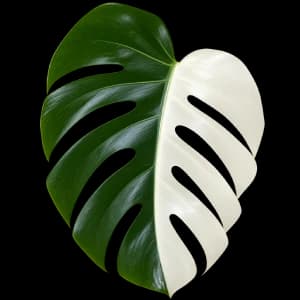
Monstera Albo Half Moon is a term used for Monstera Albo leaves that display a dramatic division between green and white, with roughly one half of the leaf being green and the other half predominantly white. This strong contrast makes the Half Moon pattern one of the most desirable looks in variegated Monstera. However, “Half Moon” describes a leaf pattern rather than a separate Monstera cultivar. An Albo plant that produces a beautiful Half Moon leaf can produce a much greener, whiter, marbled, or sectoral leaf at the next growth point.
What makes Albo Half Moon special?
The appeal of an Albo Half Moon comes from the sharp visual division across the leaf blade. One side retains the deep green color of Monstera deliciosa, while the other side can be almost completely white. When the proportions are close to 50/50, the result is especially striking, with the veins and natural fenestrations extending through both color zones.
The white areas are not simply a surface color. They are leaf tissue containing little or no chlorophyll, which means those areas contribute very little to photosynthesis. The green portions of the leaf therefore do most of the work of producing energy for the plant.
Will Half Moon leaves stay consistent?
This is one of the most important things to understand when growing an Albo Half Moon: a Half Moon leaf does not guarantee another Half Moon leaf.
Albo variegation is unstable, and the pattern depends on the distribution of green and white tissue within the stem and developing growth point. A perfectly balanced Half Moon leaf therefore does not mean the next leaf will also be 50/50. The plant may produce a greener leaf, a much whiter leaf, or a leaf with marbled variegation instead.
That unpredictability is part of the experience of growing Albo. Every new leaf can reveal a slightly different expression of the plant's variegation.
Light for Albo Half Moon
Albo Half Moon performs best in bright, indirect light. Because a significant portion of the leaf may contain little or no chlorophyll, the plant needs sufficient light so that the green tissue can photosynthesize effectively. At the same time, this does not mean placing the plant in intense direct sunlight. The white areas can scorch and turn brown quickly when exposed to harsh direct light.
A bright position near a window filtered by a sheer curtain is often a good choice. If you use a grow light, consistent moderate-to-bright illumination is generally more useful than an extremely strong light source positioned directly over the foliage.
Soil and root health
Healthy roots are the foundation of strong new growth in an Albo Half Moon. The plant benefits from an airy, well-draining growing medium that can retain some moisture without becoming compacted or waterlogged. Chunky aroid-style mixes are often suitable because they create air spaces around the roots.
The goal is not simply to make the substrate dry as quickly as possible. Roots need both moisture and oxygen. If the growing medium remains saturated for too long, root health can decline and the problem may eventually show up as yellowing, soft foliage, or slow growth.
How to water
Do not water Albo Half Moon according to a fixed weekly schedule. Instead, check the growing medium directly and water when the upper portion has dried significantly. When watering, thoroughly moisten the root zone and allow excess water to drain completely from the container.
A heavily variegated Albo does not need extra water simply because the white areas are visually delicate. What matters more is maintaining a healthy wet-and-dry cycle and avoiding constantly saturated roots.
Humidity and environment
Albo Half Moon grows well in a warm environment with consistent humidity. Moderate to higher humidity can help reduce excessive drying and browning along the edges of the white sections. Some Albo care guides recommend humidity around 60% or higher for indoor growing.
However, high humidity should always be paired with good airflow. Stagnant air combined with constantly wet foliage can encourage fungal or bacterial problems. Keep the plant away from strong air-conditioning drafts as well.
Keeping the white areas beautiful
The white portions are what make an Albo Half Moon so visually impressive, but they are also the most vulnerable parts of the leaf. Harsh sunlight, prolonged dryness, very dry air, or physical damage can cause brown patches to develop across the white tissue.
Regular observation is therefore more useful than simply watching for new leaves. A soft, slightly damp cloth can be used to remove dust from both sides of the foliage, making the leaves look cleaner and making pests easier to spot. Common pests to watch for include spider mites, mealybugs, scale, and thrips.
What happens when the plant starts producing more green?
An Albo Half Moon can sometimes begin producing increasingly green leaves. This is commonly described as reversion, where new growth becomes dominated by green tissue and shows little or no visible variegation. At the other extreme, a plant may produce an almost entirely white leaf. A completely white leaf cannot produce enough energy on its own because it lacks chlorophyll.
When a plant repeatedly produces extremely green or extremely white growth, the stem and active growth point become important things to observe. A single spectacular leaf should not be used as the only measure of a plant's long-term variegation.
When should you repot?
An Albo Half Moon should be repotted when its roots have substantially filled the container, the growing medium has broken down, or drainage has noticeably changed. There is no need to move the plant into a dramatically larger pot simply to encourage faster growth.
A moderately sized container with good drainage makes moisture management easier. As the plant develops into a climbing vine, a moss pole or another sturdy support can also provide structure and encourage larger foliage over time.
Albo Half Moon – one leaf never tells the whole story
The appeal of Albo Half Moon is not only the image of a perfectly divided white-and-green leaf. The real fascination comes from not knowing exactly what the next leaf will look like.
A plant may produce a beautiful Half Moon leaf, followed by a marbled leaf, and then another leaf with much more green or white. For that reason, the goal when growing Albo Half Moon should not be to force every leaf to remain perfectly 50/50. Instead, create stable conditions that allow the plant to stay healthy and continue producing new growth.
Bright indirect light, an airy growing medium, appropriate watering, stable humidity, and healthy roots give the plant a strong foundation. And with Albo Half Moon, every new leaf comes with a little surprise.
Reviews
No reviews yet. Be the first to share your experience.