Monstera
Albo
Sectoral variegation: keep a growing point with both green and white if you want the pattern to last.
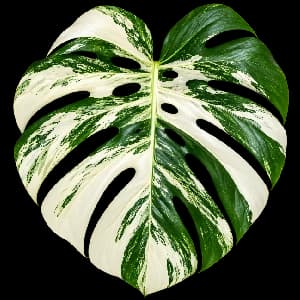
Monstera Albo, commonly known as Monstera deliciosa ‘Albo Variegata’, is admired for its striking white variegation across deep green leaves. Some leaves may carry only a few delicate white streaks, while others develop large sectors, marbled areas, or clearly divided green-and-white sections. This variation gives Albo much of its appeal: every new leaf can reveal a pattern that looks different from the leaves that came before it.
What makes Monstera Albo special?
The main attraction of Albo is the contrast between deep green and white tissue. The green portions contain chlorophyll and perform most of the plant's photosynthesis, while the white areas contain little or no functional chlorophyll. As a result, highly variegated Albo plants can grow more slowly than fully green Monstera and benefit from stable growing conditions.
There is no single fixed Albo pattern. Variegation can appear as fine streaks, marbling, large sectors, or a combination of different patterns on the same leaf. Even leaves produced by the same plant can have dramatically different proportions of green and white.
Every Albo leaf can look different
One of the most enjoyable parts of growing Albo is waiting for a new leaf to unfurl. One leaf may have a beautifully balanced distribution of white, while the next may be much greener or develop a much larger white section.
This happens because the pattern of new foliage depends on the tissue and active growth point developing within the stem. A spectacular Albo leaf therefore does not guarantee that the next leaf will repeat the same pattern. The expression can change considerably between growth cycles.
For this reason, it is better not to judge an Albo plant from its most attractive leaf alone. Looking at several leaves, the stem, and the active growth point gives a more realistic picture of how the plant is developing.
Light for Monstera Albo
Albo prefers bright, indirect light. Because the white portions contribute little to photosynthesis, the plant benefits from enough light for the green tissue to remain productive. A bright position near a window with filtered sunlight is often suitable, provided the plant is protected from prolonged exposure to intense direct sun.
However, more light does not mean that stronger direct sunlight is always better. The white portions can scorch more easily under intense exposure, particularly when the plant has not been acclimated to high light. If you increase the light level, do it gradually and observe the foliage.
Soil and root health
A healthy Albo starts with a healthy root system. The plant benefits from a well-draining, airy growing medium that contains organic material while retaining enough moisture between waterings. A chunky aroid-style mix can create useful air pockets around the roots and reduce compaction.
The goal is to balance moisture and oxygen. A dense substrate or constantly wet root zone can weaken the roots, which can eventually slow the development of new foliage.
Watering Albo
Albo should not be watered according to a rigid calendar. Check the moisture level of the growing medium and allow the upper portion to dry noticeably before watering again. When watering, thoroughly moisten the root zone and allow excess water to drain completely.
A plant with a lot of white variegation does not need extra water simply because the foliage looks delicate. In fact, keeping the growing medium constantly wet can reduce oxygen around the roots and increase the risk of root problems. A consistent watering cycle based on the actual drying rate of the pot is more useful than watering on a fixed day.
Humidity and environment
Albo grows well in a warm, stable environment with relatively good humidity. Very dry conditions can make the edges and white portions of developing leaves more vulnerable to drying and browning.
At the same time, higher humidity should be paired with good airflow. Stagnant air combined with an overly wet growing medium is not ideal. Indoors, keep Albo away from strong cold air-conditioning drafts and direct heat sources.
Keeping the white areas beautiful
The white portions are the defining visual feature of Albo, but they are also more vulnerable to visible damage. Intense sunlight, prolonged underwatering, very dry air, or physical damage can cause brown patches to develop across the white tissue.
Gently wiping the leaves with a soft, slightly damp cloth removes dust and makes the green-and-white contrast more visible. It is also a good opportunity to inspect the undersides of the leaves and petioles for pests.
As the plant becomes larger, rotating the pot occasionally can help different sides receive more balanced light. If you want Albo to develop larger foliage, a moss pole or sturdy climbing support can also provide useful structure.
What happens when Albo becomes greener?
An Albo plant can sometimes begin producing increasingly green leaves. This is something worth watching because the variegation can change between different growth points. Green tissue can become more dominant, resulting in new leaves with less visible white.
At the opposite extreme, an almost completely white leaf is not necessarily a good sign. Because white tissue contains little chlorophyll, the plant needs enough green tissue to maintain photosynthesis. A reasonable balance between green and white tissue generally provides a stronger foundation for continued growth.
Propagating Monstera Albo
Albo is propagated from stem sections containing a node, rather than from a leaf or petiole without a node. Monstera deliciosa generally requires a node for new roots and shoots to develop.
With Albo, node selection is especially important because the variegation of the new plant depends on the growing tissue retained in the stem cutting. A node showing both green and pale or white tissue is generally more desirable when the goal is to preserve variegation than an entirely green section. However, even a well-selected cutting cannot guarantee that the next leaf will reproduce exactly the same pattern as the parent plant.
When should you repot?
Albo does not need frequent repotting. Consider repotting when the root system has developed substantially, the container has become crowded, the growing medium has broken down, or drainage has noticeably changed. Monstera deliciosa can generally be repotted every one to two years once established, but the actual condition of the roots and growing medium should be the deciding factor.
The new container should only be moderately larger than the previous one. An oversized pot can retain too much moisture around the root system and make watering more difficult to control.
Monstera Albo – beauty you cannot completely predict
What makes Monstera Albo so fascinating is not simply its bright white color, but the surprise contained in every new leaf. One leaf may carry delicate white streaks, another may develop large sectors, and another may create an entirely different balance between green and white.
Growing Albo is therefore not simply about making the plant “whiter.” The more important goal is to maintain appropriate light, healthy roots, an airy growing medium, consistent watering, and a stable environment. When these elements are balanced, Albo can develop large, healthy leaves with patterns that are uniquely its own.
Reviews
No reviews yet. Be the first to share your experience.